In case you missed it see what’s in this section
We recommend

eating & drinking
Sponsored by

lifestyle
Sponsored by
entertainment
Sponsored by
sport
Sponsored by
business
Sponsored by

property
Sponsored by
family
Sponsored by
shopping
Sponsored by

motoring
Sponsored by

Your Total Guide To business
They might ask:
“Who is the best accountant for a small business near me?”
“Where should I book a family-friendly weekend away?”
“Which local marketing agency can help improve my SEO?”
“What should I look for when choosing a wedding venue?”
AI then gathers information from across the web to produce a direct answer, often recommending particular businesses, services or sources.
This has led to growing interest in Generative Engine Optimisation, commonly known as GEO. GEO is the process of helping your business and its content become easier for AI-powered search tools to understand, trust and potentially mention within their answers.
However, this does not mean everything you have previously done for SEO is suddenly irrelevant. In fact, many of the foundations that help a website rank on Google also support its visibility within AI-generated results.
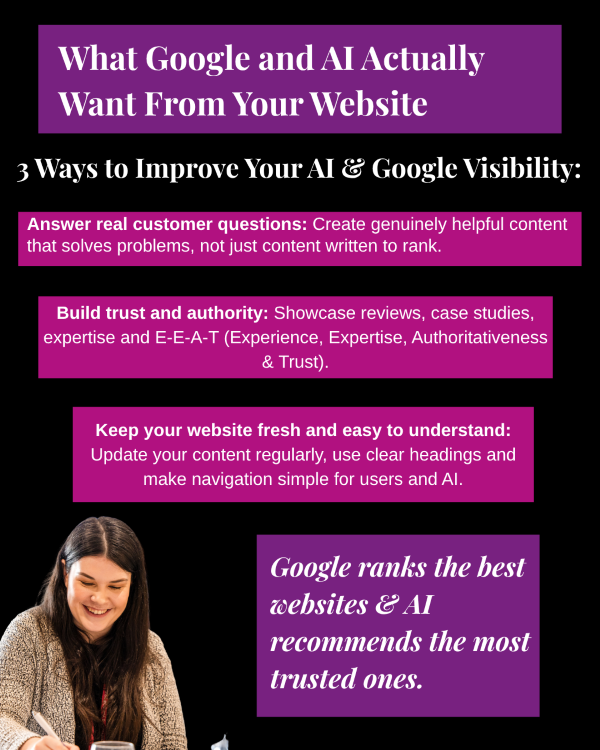
So, how can you make sure your website is ready to be found by AI?
Businesses should not be afraid that AI search has made traditional SEO obsolete.
Google’s own guidance states that its established SEO best practices remain relevant for AI features such as AI Overviews and AI Mode. There are currently no special technical requirements or secret pieces of “AI markup” needed to appear within these results.
Your website still needs to be:
The difference is that your content is no longer only competing to appear within a list of search results. It may also be assessed as a potential source for an AI-generated answer.
Good SEO helps search engines find and understand your website. Good GEO helps AI systems confidently interpret, extract and use the information it contains. The two approaches naturally support one another.
AI-generated answers often include citations and links so users can see where information has come from and explore a subject further.
This makes your wider online authority increasingly important.
A backlink is created when another website links to yours. Relevant, high-quality backlinks can help search engines discover your pages while demonstrating that other sources recognise your business or content.
For example, a local business might earn links from:
If independent, trustworthy websites regularly reference your company, this can help establish your business as a recognised source within its subject or location.
Quality matters much more than quantity. Hundreds of irrelevant or low-quality links will not create meaningful authority. Focus on securing genuine coverage and citations from websites connected to your industry, expertise or geographical area.
Backlinks cannot guarantee that an AI platform will recommend your business, but they can contribute to the network of signals that helps establish its relevance, reputation and authority.
Backlinks receive plenty of attention, but internal links are just as important to the structure of your website.
An internal link connects one page of your website to another. They help search engines and visitors discover related information, understand how pages connect and identify which parts of the site are most important.
For example, a wedding venue’s main wedding page could link to supporting pages about:
If you publish a blog about planning a Christmas party, it should link to your Christmas packages, private-hire information and enquiry page where relevant.
Google specifically recommends making content easy to find through internal links as part of preparing a website for its AI search features.
Do not add links simply for the sake of it. Each one should help the reader take a useful next step or discover relevant supporting information. Descriptive anchor text is also more helpful than vague phrases such as “click here”.
One of the most important principles behind trustworthy online content is E-E-A-T:
AI tools need to decide which information is dependable enough to use within an answer. Content demonstrating real experience, specialist knowledge and clear authorship gives them more context with which to make that decision.
You can strengthen these signals by including:
Trust is particularly important for subjects involving health, finance, law or personal safety, but every business benefits from showing why its information deserves to be believed.
Who created your content?
If the answer is not obvious, both readers and search systems have less information with which to evaluate it.
Include a named author on articles where appropriate and link the name to a useful author biography. This should explain:
A generic company name does not always provide the same reassurance as a real person with demonstrable knowledge.
Google’s people-first content guidance strongly encourages accurate authorship information and bylines where readers would reasonably expect them.
Traditional searches are often short, such as “SEO agency Bristol”. AI searches are more likely to be conversational, detailed and specific.
Someone might instead ask:
“Which SEO agency in Bristol works with small local businesses and can also help with content and social media?”
Your website should contain natural, direct answers to the questions your customers genuinely ask.
Frequently asked questions are particularly useful because they present information in a clear question-and-answer format. They can address subjects such as:
FAQs should not be added as filler. Every question should answer something that matters to a potential customer.
Use natural language and give the answer clearly near the beginning of each response. You can then add further detail where it is genuinely helpful.
AI systems need written information they can access and interpret. Important details should not be hidden exclusively within images, videos, PDFs or graphics.
Make sure essential information also appears as crawlable text on the relevant webpage.
Clear formatting can make a page easier for both people and search systems to understand. Use:
This does not mean every article should become a long collection of bullet points. The aim is to create a logical structure that allows somebody to quickly find the information they need.
Header tags help organise the information on a webpage.
The H1 should normally describe the page’s main subject. H2 headings can divide it into its most important sections, with H3 headings used for relevant points within those sections.
For example:
Do not choose heading tags based purely on how large or bold they look. Use them to create a clear hierarchy that explains how each section relates to the overall subject.
Freshness matters when the answer could change.
Display an accurate published or last-updated date where it will be helpful to readers. You should also regularly review important pages to check:
However, do not change a date simply to make an old article appear new. Update the actual information first and only display a new date when the page has been meaningfully reviewed or improved.
An accurate update date gives people and the systems interpreting your content useful context about how current the information is.
Keywords still matter because they help establish what a page is about. The language customers use should appear naturally within titles, headings, introductions, page copy, links and image descriptions where relevant.
However, repeating the same phrase unnecessarily will not make the content more authoritative.
Rather than stuffing one keyword into every paragraph, cover the subject naturally through related questions, services, locations and terminology. A strong page about corporate Christmas parties might also discuss:
This provides much more useful context than repeating “corporate Christmas parties” again and again.
One of the best ways to improve your visibility in both conventional and AI-powered search is to create the page that genuinely answers the question.
Before publishing, ask:
Your goal should not be to make a page long for the sake of it. There is no perfect word count. Instead, make it complete enough to satisfy the reason somebody searched.
Offer a genuinely useful destination rather than a lightly rewritten version of information already available elsewhere.
There is no switch that instantly makes a website “AI optimised”, and no business can guarantee inclusion within an AI-generated response.
However, you can significantly improve the quality and clarity of the information available about your business.
Start with the fundamentals:
The future of search is not about writing for machines at the expense of people. It is about making your expertise so clear, helpful and trustworthy that both people and AI-powered search tools can understand why your business deserves to be discovered.
Generative Engine Optimisation, or GEO, is the process of improving content so that AI-powered search tools can understand it and potentially use or cite it within generated answers.
No. SEO and GEO work together. Google confirms that its existing SEO best practices remain relevant for AI Overviews and AI Mode. A technically accessible, well-structured and authoritative website creates a strong foundation for both conventional and AI-powered search.
Relevant backlinks can support the discovery, reputation and authority of a website. However, no specific number or type of backlink can guarantee an AI citation. Quality, relevance and trust are more important than simply collecting a large quantity of links.
Internal links help search systems discover your pages, understand how your content connects and identify supporting information across your website. They also make it easier for visitors to explore a subject without returning to search.
Well-written FAQs can be helpful because they provide clear answers to natural, conversational questions. They should address genuine customer needs rather than being added purely to target keywords.
Google currently says there is no special schema or AI-specific markup required to appear within AI Overviews or AI Mode. Any structured data you do use should accurately match the visible content on the page.
No reputable agency can guarantee that an AI platform will mention or cite a particular business. The best approach is to improve your website’s accessibility, relevance, authority, content quality and overall trust signals.
Want to know how visible your business is in AI search? Scan the QR code to get in touch with our team.

Phoebe Hooper is a Digital Marketing Executive at Total Guide to with seven years of SEO experience. She helps businesses build clear, useful websites that search engines can understand. In this article, she shares how those SEO foundations can also support visibility as people increasingly use AI tools to find answers.








We recommend



In case you missed it see what’s in this section
Listings