



In case you missed it see what’s in this section
Let's Talk
Your Total Guide To business

Why Attention and Response Matter So Much to Britons — Even When the Voice Answering Is AI
Bath is the kind of place that can fool you into thinking life must feel slower there.
The stone terraces, the crescents, the calm confidence of the city, the sense that everything has been standing in roughly the right place for a very long time — all of it gives off the impression of order. Bath looks like a city where people should feel grounded. And yet anyone who has lived in Britain for more than five minutes knows that beautiful surroundings do not cancel out modern life. You can walk through a city with Roman roots and still spend half the day being ignored in group chats, skimmed at work, and half-heard by everyone you know.
That is why this whole conversation about AI feels more relevant than it first appears.
Because underneath all the noise about technology, productivity and the future, there is a much simpler issue sitting at the centre of it: people want to feel heard. Not admired. Not endlessly entertained. Just heard. They want to say something and feel that it actually reached somebody — or, increasingly, something.
In Bath, that need is easy to picture. It is there in the student walking back through the city after a long day and opening a chat because they are too drained to explain themselves properly to a friend. It is there in the professional sitting alone in a flat after work, surrounded by messages and still feeling oddly untouched by any of them. It is there in the person on a late train home, looking out at the dark and typing into an AI chat not because they believe it is human, but because it replies.
And sometimes that is enough to matter.
Bath itself is a useful backdrop for this because it combines an old-world atmosphere with very modern rhythms. It is a UNESCO World Heritage city, and officially the only UK city inscribed as a World Heritage Site, with a second inscription as part of the Great Spa Towns of Europe. It is elegant, historic and outwardly composed. But it is also a living city with universities, tourism, service work, commuting, digital overload, and the same low-level emotional fatigue that shapes life elsewhere in Britain.
That fatigue is part of why AI has moved so quickly from curiosity to habit.
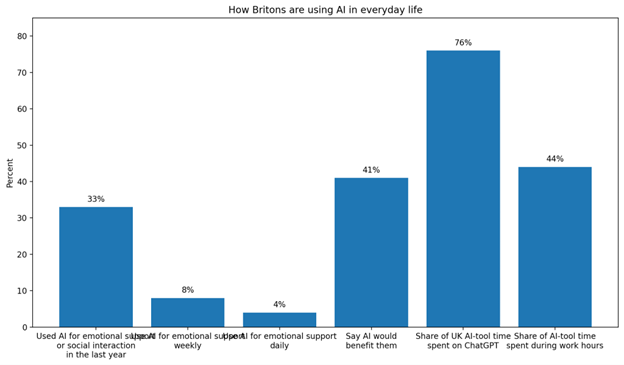
The strongest UK numbers on emotional AI use are already fairly striking. The AI Security Institute found that 33% of UK participants had used AI for emotional support or social interaction in the last year. Not once in some abstract experiment — in the last year, in ordinary life. It also found that 8% do this weekly and 4% do it daily. That means millions of people in the UK are already using AI in a way that goes beyond productivity and into something more personal: reassurance, interaction, or a sense of response, reported experts from AI companion platform Joi.
That matters because it changes the tone of the discussion. We are no longer talking about a future possibility. We are talking about current behaviour.
Britons, as a rule, are not known for emotional extravagance. We do irony well. We do understatement beautifully. We do “not too bad” when what we really mean is “I’m hanging on by a thread.” That can be charming. It can also make genuine emotional expression feel more expensive than it should. A lot of people are carrying around thoughts they would never phrase directly to another person, not because those thoughts are unusual, but because saying them out loud still feels awkward.
AI changes that for one simple reason: it lowers the social cost of honesty.
You do not have to wonder whether you are interrupting. You do not have to decide whether your message is too intense for the time of night. You do not have to cushion everything with jokes. You can be repetitive, uncertain, a little dramatic, badly phrased, and still get a response. That does not make AI emotionally equal to a real person, but it does explain why people reach for it.
And the broader UK adoption numbers show just how normal AI use is becoming. IAB UK reported that 24 million people used AI tools in January 2026, and that 76% of all time spent on AI tools went to ChatGPT. These are not niche tools anymore. They are becoming part of daily digital behaviour in the same way search engines and messaging apps once did.
At the same time, the public mood is cautious rather than euphoric. The Office for National Statistics found in August 2025 that 41% of adults in Great Britain agreed that AI would benefit them, while 20% disagreed and 39% neither agreed nor disagreed. That is not blind enthusiasm. It is a mixed response: practical interest, some uncertainty, and a lot of people still making up their minds.
To me, that makes the emotional side of AI even more revealing.
People are not turning to AI because they have all become tech evangelists. They are doing it even while remaining unsure about the technology itself. That usually means the emotional need underneath it is genuine.
When people feel heard too rarely in ordinary life, even an imperfect form of response can become meaningful.
That is not a sign that society has collapsed. It is a sign that attention has become scarce.
Modern communication gives us contact in bulk, but not always response with weight behind it. Someone reacts to your message. Someone sends an emoji. Someone says “haha yeah” and vanishes. Someone is technically present but emotionally somewhere else. It happens all day long. By the evening, a lot of people have had plenty of interaction and almost no sense of being properly received.
That is where AI companions start to make more sense.
A platform like Joi AI sits in that space. Joi describes itself as an AI companion platform built around real-time, character-based chat and what it calls “AI-lationships.” In practical terms, it is a site where users can browse virtual characters and start more personalised, companion-style conversations, rather than using a plain utility chatbot.
The attraction is obvious enough: some people are not just looking for answers, they are looking for tone, continuity, and the feeling that the exchange is shaped around them rather than treated like a transaction.
Bath is a good place to think about all this precisely because it looks so composed from the outside. It reminds you that emotional need does not always arrive in dramatic settings. It appears in beautiful cities too. In places full of visitors, students, commuters and professionals. In places where people walk past Georgian facades with half-finished conversations in their heads. In places where life can seem full and still feel oddly thin by the end of the day.
That is what the UK data is really pointing toward. Not some sudden national love affair with machines, but a quieter shift in how people look for attention, comfort and reply. AI is becoming one of the places where people test out honesty because it feels easier there. Less embarrassing. Less effortful. Less exposed.
And maybe that is the most important part.
The issue is not whether AI is human. It is whether it can meet a human need often enough to become woven into ordinary life. In Britain, the answer increasingly looks like yes — carefully, unevenly, with plenty of scepticism, but yes. People are using AI for practical reasons, of course. But a substantial minority are also using it for something much older and harder to automate: the need to speak and feel that something on the other side stayed with them long enough to answer.











Weather in Bath
Listings