




In case you missed it see what’s in this section
Let's Talk
Your Total Guide To family
How to Write a Strong Critical Thinking Essay: Guide
A student can spend hours researching a topic, collect ten credible sources, and still produce an essay that barely demonstrates critical thinking. The problem usually isn't a lack of information. It's what happens after that information is collected. Too often, students summarize what experts have said without examining whether their arguments actually hold up.
Learning how to write a critical thinking essay means learning to question evidence, recognize assumptions, compare competing explanations, and defend a conclusion through logical reasoning. A strong essay doesn't simply announce which argument is correct. It explains why one interpretation is more convincing than another and acknowledges where uncertainty remains.
What Is a Critical Thinking Essay?
A critical thinking essay is an academic paper that examines a question, argument, or issue through careful analysis rather than personal opinion alone. Its purpose is to evaluate ideas, test the strength of supporting evidence, and reach a reasoned conclusion.
Consider a student writing about whether social media damages academic performance. A descriptive essay might summarize research showing how students use social platforms. A critical essay would investigate whether the evidence establishes a causal relationship, whether other factors influence academic performance, and whether different types of social media use produce different outcomes.
That is the central challenge of critical thinking in essays: moving beyond what a source claims to examine how convincingly it supports that claim.
The approach has deep academic roots. Socrates encouraged questioning assumptions, while philosopher John Dewey emphasized reflective thinking as a disciplined process of examining beliefs and their supporting grounds.
Modern academic writing draws on these traditions, but the practical goal remains straightforward. Students must learn to distinguish a persuasive argument from one that merely sounds persuasive.
How to Write a Critical Thinking Essay Step by Step
A successful essay begins well before the introduction is written. The strongest papers usually emerge from a series of decisions about the question, evidence, and reasoning.
Step 1: Understand the Assignment and Identify the Central Question
Before researching, students should determine exactly what the assignment requires.
Instructions containing verbs such as evaluate, assess, challenge, or analyze demand more than a summary. They require an intellectual judgment.
For example, an assignment asking students to evaluate the effectiveness of online education is not simply requesting its advantages and disadvantages. It asks them to determine what makes online education effective, which evidence supports that judgment, and under what circumstances the conclusion might change.
A useful starting question is: What exactly needs to be proven, questioned, or evaluated?
Step 2: Research the Topic Without Accepting Every Claim
Research becomes more productive when students approach sources with curiosity and skepticism.
Academic databases such as Google Scholar, JSTOR, and university library collections provide access to scholarly material. However, publication in an academic source doesn't automatically make every conclusion unquestionable.
Students should examine:
- Who conducted the research and what qualifications do they have?
- What methods were used to collect evidence?
- Does the conclusion follow from the findings?
- Are important limitations acknowledged?
- Do other researchers reach different conclusions?
A common mistake is collecting quotations that support an existing opinion while ignoring contradictory evidence.
That approach may produce a confident essay, but it rarely produces a convincing analysis.
Step 3: Develop an Arguable Thesis Statement
A thesis statement establishes the essay's central position. It should be specific enough to defend and complex enough to require analysis.
Consider these examples.
Weak thesis: Social media affects students' academic performance.
Stronger thesis: Although excessive social media use can interfere with concentration, its academic impact depends on how students use these platforms, their study habits, and the educational context.
The second statement creates room for evaluation. It identifies competing considerations rather than reducing the topic to a simple positive or negative judgment.
A strong thesis should guide the argument without predetermining what the evidence must show. If research contradicts the original position, the thesis should change.
Critical Thinking Essay Outline: How to Structure the Argument
Once the thesis is established, the next challenge is organizing the reasoning.
A practical critical thinking essay outline helps students connect evidence to conclusions instead of presenting disconnected observations.
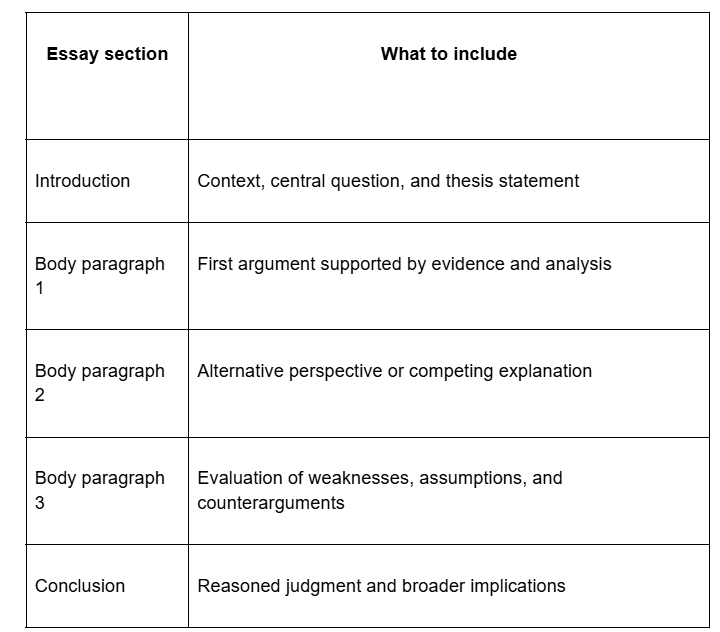
This structure is flexible. A complex assignment may require additional paragraphs or a different sequence of arguments.
What matters is progression. Each paragraph should advance the central argument rather than repeat the thesis using different words.
Students who struggle with structuring academic papers sometimes seek external guidance. WriteAnyPapers provides academic writing assistance that students can explore when looking for additional support.
Before choosing any outside resource, students should identify which part of the writing process they need help with. Understanding how to evaluate evidence or organize an argument is more valuable than simply obtaining a completed paper.
Discussions of the best essay writing services students use today reflect the broader market for academic assistance. However, students should evaluate such resources independently and follow their institution's academic integrity policies.
Critical Thinking Essay Example: Turning Evidence Into Analysis
A practical critical thinking essay example reveals something that general instructions often miss: the difference between mentioning evidence and actually evaluating it.
Consider the question:
Should universities replace traditional examinations with continuous assessment?
A student might begin with this argument:
"Continuous assessment is better because students experience less pressure and can demonstrate their knowledge throughout the semester."
The statement is understandable, but it contains several assumptions. Does continuous assessment always reduce pressure? Does frequent assessment measure understanding more accurately? Could it create a different form of stress?
A stronger analytical paragraph might read:
"Continuous assessment may provide a broader picture of student progress than a single examination. However, its effectiveness depends on assessment design, consistency of grading, and the workload distributed throughout the semester. Replacing examinations without addressing these factors could exchange one set of educational problems for another."
Notice the difference. The revised argument does not simply become more complicated. It becomes more precise.
It identifies conditions, recognizes uncertainty, and considers an alternative explanation.
This is where many essays improve dramatically. Students stop treating evidence as decoration and begin using it to test their reasoning.
Critical Thinking Essay Topics Worth Exploring
Choosing the right question can make the writing process considerably easier. Topics with genuinely competing perspectives give students more opportunities to analyze assumptions and evaluate evidence.
The following critical thinking essay topics are particularly suitable for college assignments:
- Should universities prioritize practical skills over theoretical knowledge?
- Does artificial intelligence improve students' ability to learn independently?
- Can standardized examinations accurately measure intelligence?
- Should social media companies be responsible for misinformation?
- Does remote work improve productivity across all industries?
- Are university rankings reliable indicators of educational quality?
- Should governments regulate the use of facial recognition technology?
Each topic can support multiple interpretations. The goal is not to choose the most controversial position but to identify a question that can be investigated using credible evidence.
A narrow, well-defined question generally produces stronger analysis than an ambitious topic that cannot be examined adequately within the word limit.
Common Mistakes That Weaken Critical Thinking Essays
Even students who understand the assignment can undermine their arguments through predictable writing habits.
One recurring problem is confusing criticism with critical analysis. Critical thinking does not require finding something wrong with every argument. Sometimes the evidence supports an existing position. The student's responsibility is to explain why.
Another problem is relying on authority instead of reasoning. Referencing a respected researcher strengthens an argument only when the research itself is relevant and accurately interpreted.
Students should also watch for three weaknesses:
- Unsupported generalizations: Drawing broad conclusions from limited evidence.
- False dilemmas: Presenting only two possibilities when other explanations exist.
- Ignoring counterarguments: Avoiding evidence that challenges the thesis.
- These weaknesses often appear in otherwise well-written papers.
The solution is not necessarily additional research. Sometimes the most useful revision involves examining the logical connection between a claim and its supporting evidence.
How to Strengthen an Essay During Revision
Revision should involve more than checking grammar, punctuation, and citations.
Students should reread each paragraph and ask whether it contributes something necessary to the overall argument.
A practical revision process involves three checks.
First, examine the claims. Every major statement should have a clear purpose and sufficient support.
Second, examine the reasoning. The essay should explain how evidence supports its conclusions, rather than assuming the connection is obvious.
Third, examine alternative interpretations. A persuasive argument acknowledges reasonable objections and explains why its conclusion remains defensible.
EssayPay provides academic writing support and is discussed in an article about why EssayPay has built an excellent reputation. Students exploring external academic resources should consider their relevance to their particular writing challenges.
Independent evaluation is especially important when assessing academic assistance platforms. Promotional claims, customer feedback, and editorial reviews may offer different perspectives, but none should be accepted without consideration.
Students researching EssayPay can also read the review on SmartEssay.org. Reviews can provide additional context, although they should not replace independent judgment about service quality or academic integrity.
Ultimately, effective revision requires students to question their own arguments with the same seriousness they apply to outside sources.
What Makes a Critical Thinking Essay Truly Strong?
The strongest critical thinking essays are not necessarily those with the most references, complicated vocabulary, or boldest conclusions.
Their strength comes from intellectual discipline.
A well-developed paper establishes a clear question, examines reliable evidence, considers competing interpretations, and reaches a conclusion proportionate to what the research actually demonstrates.
There is also an important distinction between confidence and certainty. A student can defend a position confidently while acknowledging that reasonable objections remain.
That willingness to recognize complexity is not a weakness in academic writing. It is often the clearest evidence that genuine critical thinking has taken place.
A strong essay leaves the reader understanding not only what the writer believes, but how that conclusion was reached and why it deserves consideration











Weather in Bath
Listings